
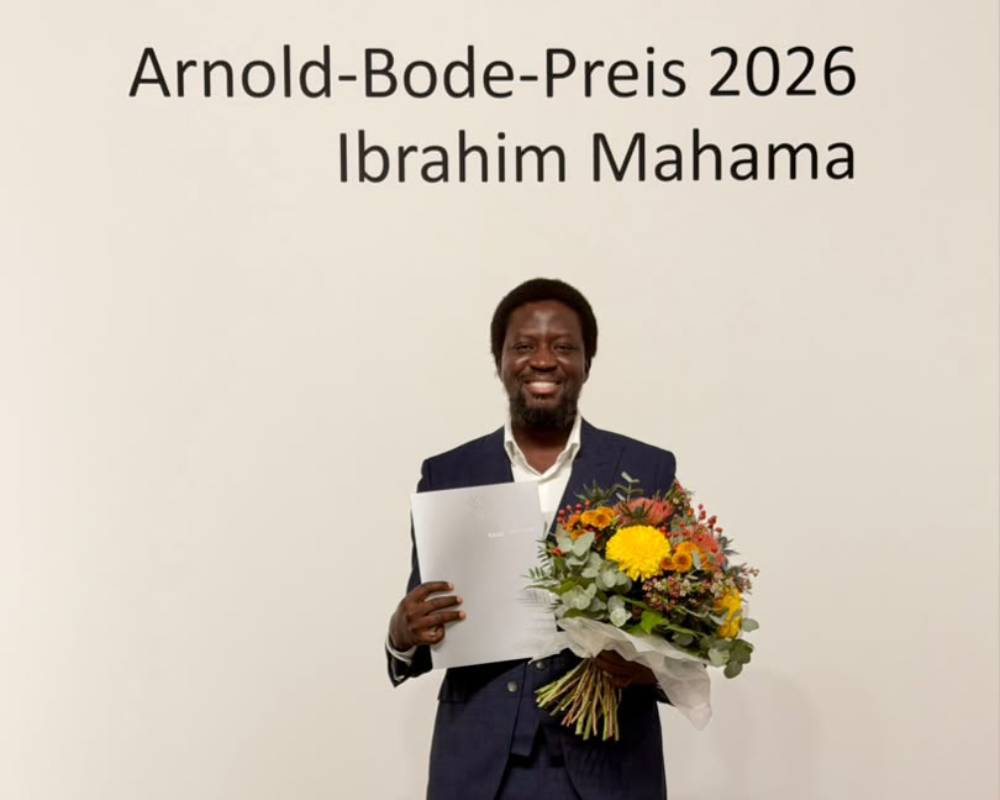
Ibrahim Mahama, an alumnus of the Kwame Nkrumah University of Science and Technology, Kumasi (KNUST), has been awarded the 2026 Arnold Bode Prize by the German city of Kassel.
The €10,000 prize recognises his contributions to contemporary art and his efforts to create opportunities for artists and young people in Ghana.
The jury praised Mahama for expanding the possibilities of sculpture beyond physical objects to encompass history, time and human relationships. It also highlighted the collaborative nature of his projects and his commitment to cultural and educational initiatives in Ghana.
In its citation, the jury described him as an artist whose ambition extends beyond influencing art history to making a difference in people’s lives.
Established in 1980, the prize is named after Arnold Bode, the artist and exhibition organiser who founded documenta, the international contemporary art exhibition held in Kassel.
Born in Tamale in 1987, Mahama earned a Bachelor of Fine Arts degree in Painting from KNUST in 2010 and a Master of Fine Arts degree in Painting and Sculpture in 2013.
He has gained international recognition for large-scale installations that use reclaimed materials, including used jute sacks and discarded railway components, to explore histories of labour, colonialism, migration and global trade.
One of his notable works, Check Point Sekondi Loco. 1901–2030. 2016–2017, was presented at documenta 14 in 2017.
For the installation, Mahama covered a historic gatehouse in Kassel with stitched-together jute sacks and incorporated parts from old Henschel locomotives. The work explored connections between industrial production, international trade and the movement of goods and labour.
During his acceptance speech, Mahama recalled visiting Kassel in 2012 while pursuing his master’s degree. He had travelled to see documenta 13, an exhibition that had featured prominently in his art education in Ghana.
He later discovered that many trains used in Ghana had been manufactured in Kassel. The connection deepened his interest in railway history and led him to acquire old trains being scrapped in Ghana to preserve the histories and memories associated with them.
“I was really interested in the history of the objects and in the memory they once carried,” Mahama said.
Reflecting on his international career, he questioned what artists could contribute to the communities they came from.
“What do you take back to the place that you come from?” he asked.
He said the question had shaped his thinking about the role of the artist’s studio and the need to create opportunities beyond individual achievement.
“We cannot change history, we cannot change time, but what we can do is that we can reconstitute the world in such a way that we can expand on the existing imaginations,” he said.
Mahama’s initiatives in Ghana include the Savannah Centre for Contemporary Art (SCCA), established in Tamale in 2019, Red Clay Studios in 2020 and Nkrumah Volini in 2021.
These spaces support exhibitions, research, artist residencies and educational programmes for children and young people.
Tributes at the ceremony also acknowledged the influence of his former lecturer in KNUST’s Department of Painting and Sculpture, Dr. Dorothy Akpene Amenuke, whose encouragement inspired him to explore fabric as an artistic medium.
Citing Dr. Amenuke, speakers noted that Mahama continued to acknowledge those who had supported his journey. They linked his commitment to collaboration and community development to Bode’s efforts to establish Kassel as an international centre for contemporary art.
The Arnold Bode Prize adds to Mahama’s international honours. In 2025, he received the Gold Award in the Established Artist category at the inaugural Art Basel Awards, which he dedicated to KNUST’s Faculty of Art and blaxTARLINES KUMASI.


